Design Judgment in Data Visualization Practice
Paul Parsons, Colin M. Gray, Ali Baigelenov, Ian Carr
External link (DOI)
View presentation:2020-10-29T14:10:00ZGMT-0600Change your timezone on the schedule page
2020-10-29T14:10:00Z
Fast forward
Direct link to video on YouTube: https://youtu.be/buhJd5BAsfg
Keywords
Index Terms: Human-centered computing-Visualization,
Abstract
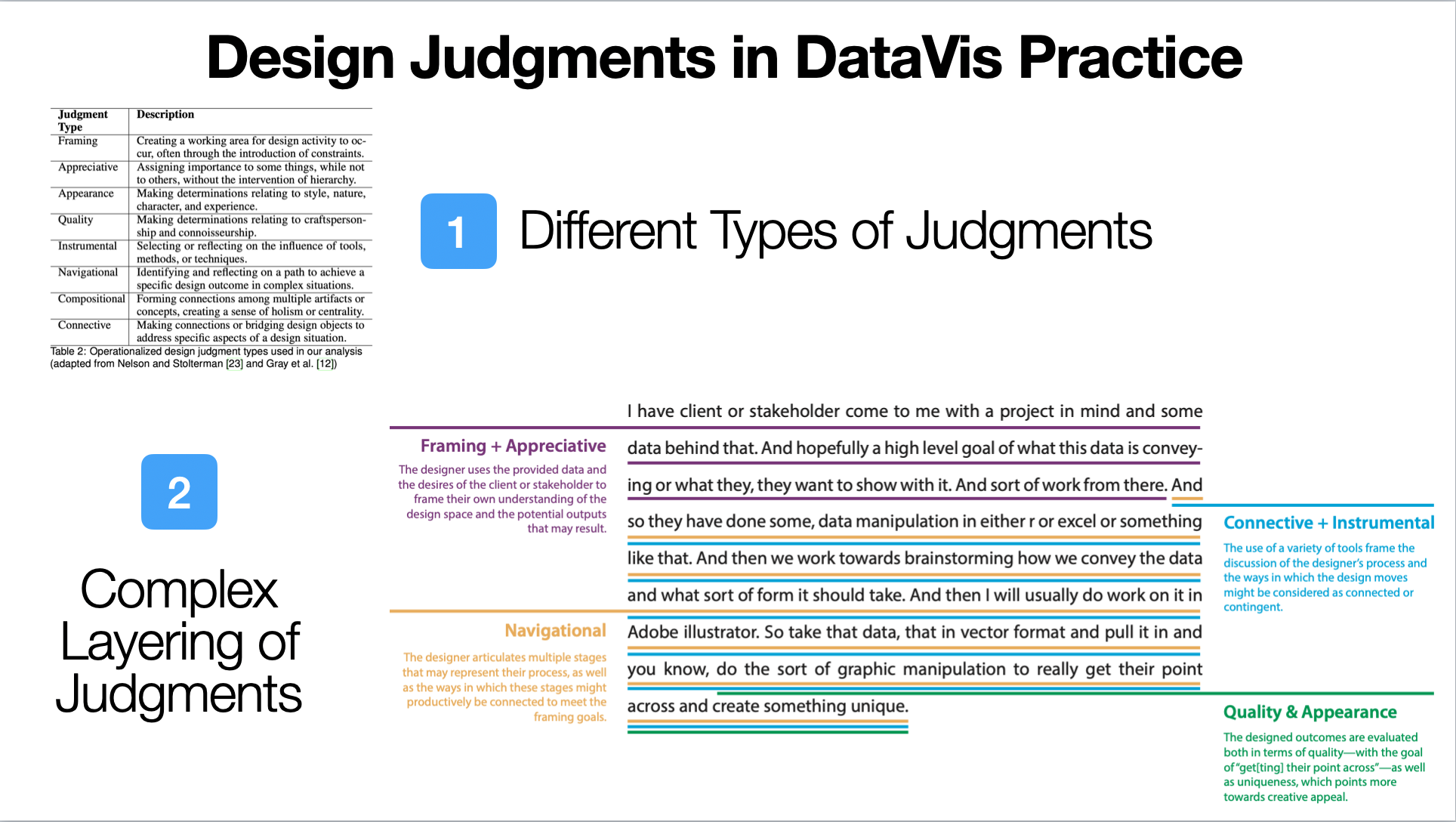
Data visualization is becoming an increasingly popular field of design practice. Although many studies have highlighted the knowledge required for effective data visualization design, their focus has largely been on formal knowledge and logical decision-making processes that can be abstracted and codified. Less attention has been paid to the more situated and personal ways of knowing that are prevalent in all design activity. In this study, we conducted semi-structured interviews with data visualization practitioners during which they were asked to describe the practical and situated aspects of their design processes. Using a philosophical framework of design judgment from Nelson and Stolterman [22], we analyzed the transcripts to describe the volume and complex layering of design judgments that are used by data visualization practitioners as they describe and interrogate their work. We identify aspects of data visualization practice that require further investigation beyond notions of rational, model- or principle-directed decision-making processes.